
Inside Floyd County Property Tax Records
Three offices split the tax record in Floyd County. The Assessor values land and improvements. The Auditor applies deductions, keeps the transfer book, calculates rates, and runs tax-sale administration. The Treasurer issues and collects the bill. A complete property search touches all three, and that prevents a common mistake: treating a tax balance, an assessment, and a sale price as if they were one figure.
| Field | What It Shows | Where |
|---|---|---|
| Land and improvement values | Separate components that make up total assessed value | Assessor / Beacon |
| Total assessed value | The tax base before applicable deductions | Assessor / DLGF search |
| Deductions | Reductions administered through the Auditor | Auditor and parcel record |
| Installments and status | Amounts billed, due, paid, or delinquent | Treasurer / LowTax |
| Taxing district | The local district used in calculating the bill | Tax statement |
Indiana assesses real property at 100 percent of market value-in-use, a statutory concept rather than a forecast of what a given sale might bring. The bill then layers local rates and deductions onto that assessment. A recorded consideration or sale disclosure can show a different number, because it documents a transaction rather than the annual tax math.
Find Floyd's Assessment Record Online
Start at the Floyd County Assessor, which links to Beacon, or try the Indiana DLGF assessed-value search. The statewide tool accepts partial entries and returns property details you can download. Beacon's screens vary, so match entries against the address or parcel number printed on an existing tax bill.
| Search clue | Best use | Check next |
|---|---|---|
| Street address | Locate one known property | Confirm parcel ID and taxing district |
| Owner name | Find assessed parcels associated with a name | Distinguish mailing from property address |
| Parcel or tax ID | Join assessment, map, and bill | Preserve punctuation shown by the system |
When Beacon cannot resolve a changed address, a split parcel, or a newly transferred property, the Assessor's office can help in person or by phone. For map context, the county parcel maps guide is the next stop.
Note: A parcel identifier is a better cross-office key than an owner name, which can change or be formatted differently.
Land, Improvements, and the Floyd Tax Base
A parcel card often breaks the assessment into land, buildings, and other improvements. It then totals those parts. Compare figures from the same assessment year. Indiana's annual adjustment uses market evidence to update values between inspections. Cyclical reassessment adds a recurring field review on top of that. Per DLGF, the statewide cycle begins July 1, 2026. It inspects roughly one quarter of parcels per year for 2026 Pay 2027 taxes. Keep that timing in mind when older parcel data looks stale.
- Assessed value
- The value used as the starting tax base under Indiana assessment rules.
- Market value-in-use
- Indiana's standard for the property's value in its current use.
- Deduction
- An authorized reduction applied through the county Auditor when eligibility requirements are met.
- Tax lien
- A legal claim arising from unpaid property taxes; it is not the same as the bill itself.
Floyd County Deductions and Homestead Clues
Deductions shrink taxable value. They do not rewrite the land or improvement assessment itself. The Auditor administers deductions, including homestead-related records. Check the parcel record and tax bill to see whether an expected deduction appears. Then ask the Auditor about eligibility, filing, or a missing entry. Do not assume the named owner occupies the property just because a mailing address or deduction shows up. Ownership, occupancy, and eligibility are separate questions.
Record distinction. A deduction changes the tax calculation; it does not establish market price or prove legal title.
Trace a Floyd County Tax Bill
The Floyd County Treasurer links to the LowTax tax-information service and posts payment methods, due-date notices, and tax-sale details. Carry the parcel identifier from the assessment record into the bill lookup.
- Locate the parcel in LowTax through the Treasurer's official page.
- Match the tax ID and site address rather than relying on the owner name alone.
- Read the installment amounts and payment status for the intended tax year.
- Compare deductions and assessed value with the Assessor/Auditor record.
- If delinquent, verify current status and any sale notice directly with the Treasurer.
- Tax year
- The assessment and collection period identified on the statement.
- Installment
- One of the scheduled portions of an annual bill.
- Payment status
- The Treasurer's record of whether an amount remains due.
The website is not the only channel. The Treasurer accepts the payment routes listed on its current page and can explain a balance by phone or at the counter. A bill reprint costs $1. For an identifiable nonconfidential county record not otherwise available, a written Indiana APRA request works, though routine parcel questions belong with the responsible office first.
The Scheduled 2026 Floyd Tax Sale
The Treasurer's current notice schedules Floyd County's tax sale for October 15, 2026. The sale runs entirely online through SRI Services. A delinquent balance alone does not prove a parcel is still in the sale. Lists and payment status shift. Confirm the notice, parcel entry, bidder rules, and redemption terms with the Treasurer before acting. The Treasurer owns the schedule and current bill status, while the Auditor administers tax-sale functions. That split explains a lot. One office answers payment questions. Another holds the administrative sale record. Before calling a parcel a tax-sale property, weigh the newest Treasurer notice against the parcel's current LowTax entry. A published sale date describes the county event. The parcel list shows which properties remain involved. Payments, corrections, or administrative changes can alter the list after any search. Record the notice date, parcel ID, and tax year. Ask the Treasurer which document controls if two online records clash. A tax sale is not a foreclosure sale. Floyd County Sheriff sales flow from court judgments and carry their own bidding and title-search warnings. The Treasurer's sale covers delinquent property taxes only. Identify the custodian and the proceeding first. Only then use a date, balance, or sale status in purchase due diligence.
Indiana's Assessed-Value Search in View
The DLGF assessed-value search page explains the statewide route and partial-search technique.
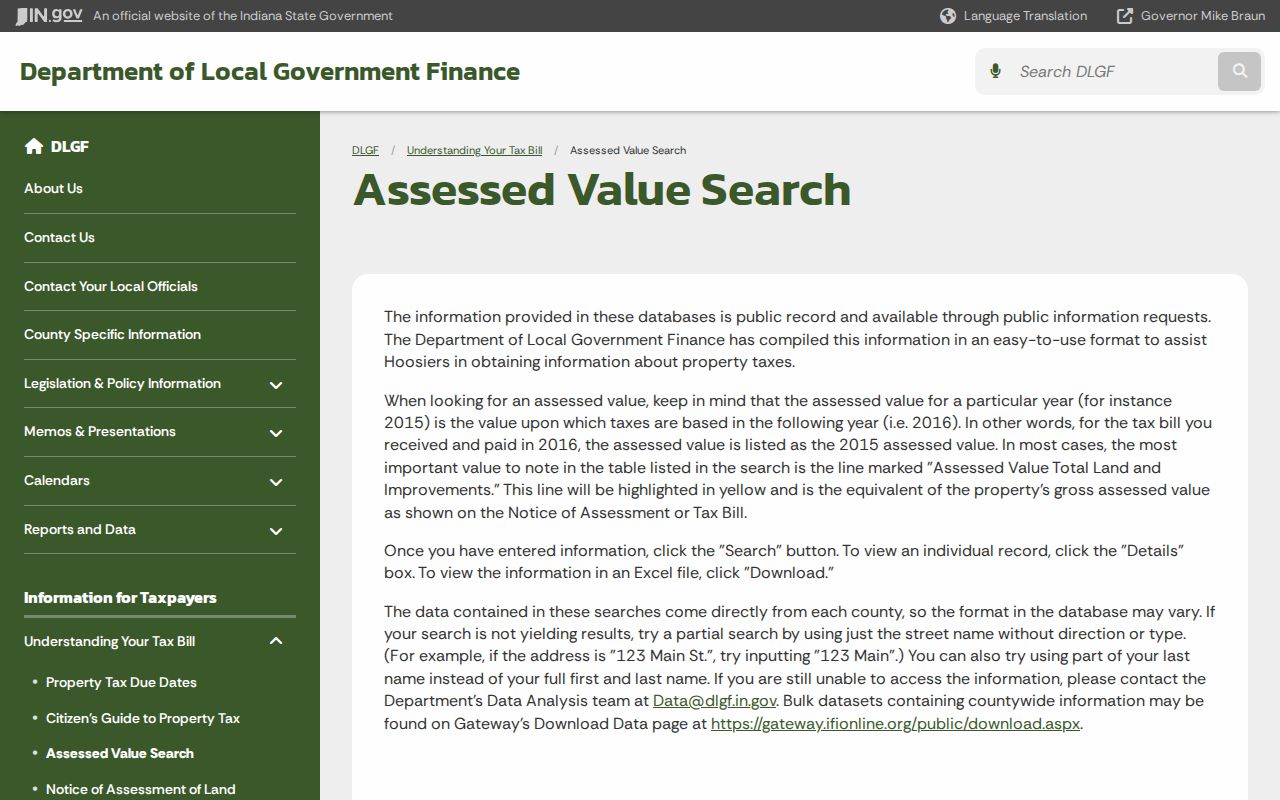
The search screen opens the door to assessment detail in Floyd County. Treat it as a first stop, not the whole picture. For the full story on a parcel, pair it with the Treasurer's tax bill records and the Auditor's deduction files.
Assessor, Auditor, or Treasurer?
| Question | Floyd County office |
|---|---|
| How was land or a building assessed? | Assessor |
| Why is a deduction absent, or how was a rate applied? | Auditor |
| Was the bill paid, and what remains due? | Treasurer |
| Who legally owns the parcel? | Recorder deed, after an initial assessor lookup |
Send a focused request with the parcel number and the tax year. Name the document you need too. For legal ownership, move from the tax roll to the recorded deed. Use the Floyd County deed search for that step.
Indiana's tax-year relationship can make two offices look like they disagree. The fix is simple. Match the assessment year or pay year each source labels. Do not compare unlabeled totals. DLGF's assessment guidance lays out the statewide framework. The county offices supply the local parcel facts, deductions, rate application, and collection status. If a card changes after a transfer or split, keep the earlier printout. Then ask which parcel number now carries the tax obligation.
The Treasurer's current page also notes its relocation to 120 West Street Spring, Suite 201. Check that official page before visiting in person. Payment instructions, due-date notices, and office details can change by collection cycle.
Appeal a Floyd County Assessment
The Assessor's guidance sets the calendar. Form 11 notices go out by April 30. An appeal is due June 15. A taxpayer starts with Form 130, which Floyd County notes replaced Form 133. Identify the parcel and the disputed year. Explain the claimed error, and attach evidence tied to the valuation issue. Comparable sales, photographs, measurements, appraisal evidence, or documentation of a factual error may all be relevant. It depends on the claim.
Confirm the current form and deadline on the Assessor's official page. Keep a dated copy and proof of delivery. An appeal challenges the assessment. It does not postpone every payment obligation automatically or decide ownership and boundary disputes.
Before filing, compare the notice with the parcel card and verify the basics. Check the correct parcel, land classification, improvement description, dimensions, and the year being challenged. Then separate a factual correction from a disagreement over valuation methodology. That distinction helps the Assessor understand the requested relief and helps the owner organize evidence. A recent split, combine, demolition, or construction project may be involved. In that case, bring the recorded plat, permit information, photographs, or survey material that connects the physical change to the assessment year.
The Property Tax Assessment Board of Appeals process is record-driven. Dates, copies, and clear parcel references matter. When a deadline is close, contact the Floyd County Assessor rather than relying on a portal banner, and use the current official version of Form 130. State DLGF guidance explains Indiana assessment principles, but the county receives the local filing.
Appeal window. Floyd County publishes June 15 after the April 30 Form 11 mailing as the filing deadline; verify the current year before submitting Form 130.