
Compare Floyd County Property Value Types
Indiana law assesses real property at 100 percent of market value-in-use, a statutory concept that differs from a broker's asking price or a private appraisal. The starting point is the Floyd County Assessor. Read the label attached to any value before you compare it with another.
| Value | What It Is | Where |
|---|---|---|
| Assessed value | Mass-appraisal amount used within Indiana's property-tax system | Assessor roll and DLGF search |
| Market value-in-use | Indiana's standard for the property's current use, expressed through assessment | Assessment methodology and notices |
| Last sale price | Consideration reported for one transfer, subject to transaction context | Sales disclosure and recorded deed clues |
| Land and improvement | Components that combine into the parcel's total assessed amount | Parcel assessment detail |
A 100 percent assessment ratio does not guarantee a match with a sale price. Mass appraisal pools market evidence across many parcels for tax administration. So individual results can drift. A single sale may involve unusual financing, related parties, bundled tracts, condition, or timing. Always check the year beside each number first.
Read Floyd County's Land and Improvement Values
Pull the land, improvement, and total assessed value from the parcel record, together with the assessment year. Floyd Beacon displays the current field labels on screen, so read them there rather than assuming the naming. Confirm the parcel number and situs too. That step keeps you from scoring the wrong tract.
Land value covers the site itself. Improvement value captures taxable buildings and other assessed structures. Total assessed value combines the applicable pieces. A torn-down garage, wrong square footage, an unrecorded split, or new construction can all explain why a Floyd County property value deserves a closer look at the records.
The Assessor processes new construction, land assessment, transfers and splits, sales disclosures, and sales validation. Each duty can move a component. A building permit may precede an improvement increase. A recorded split can shrink one tract while creating new assessment records. Match the physical-description year to the value year before crediting the whole change to market trending.
Note: Preserve the assessment year because the displayed amount and the tax year may not refer to the same calendar period.
Use Indiana's Floyd County Value Search
The Indiana DLGF assessed-value search opens a statewide doorway into county assessment data and accepts partial search terms. It works well when a strict address format fails. Search broadly, then verify the PIN, locality, and year before trusting the amount. The official search page appears below.
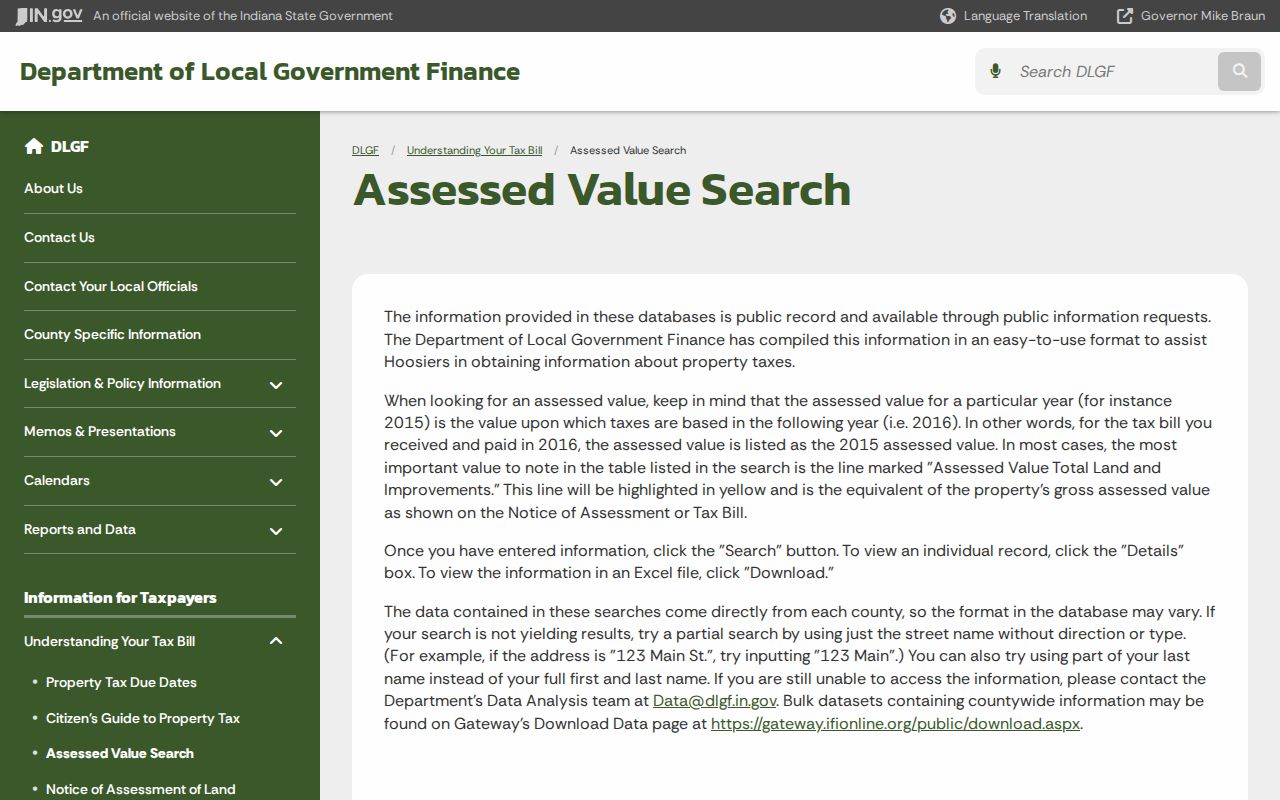
The state route locates the public assessment record. Floyd County itself remains the office for parcel-specific questions and corrections.
If the online result will not render or the address format keeps failing, the Assessor is the direct fallback at 311 Hauss Square, Room B3, New Albany, 812-948-5420, during weekday office hours. Bring a PIN when you can. An APRA request framed with reasonable particularity can seek an existing assessment record, transfer entry, sales disclosure, or notice. That request remains subject to statutory exceptions. The office does not have to build a custom valuation analysis.
Track Floyd County Property Value by Year
Indiana applies annual adjustments, often called trending, using prior-year sales evidence. Market data keep flowing into the model. A Floyd County value can therefore shift between cyclical physical inspections. Compare like years and the same parcel configuration. A recent split or combine can distort a raw year-to-year total.
Floyd County recorded 138 splits, roughly 42 combines, and 13 plats in 2024 parcel activity. A parent parcel sometimes becomes several new lots. A lower successor value may simply reflect less land rather than falling prices. Pull the plat. Map the old and new parcel numbers before drawing a trend line.
Look Up a Floyd County Assessed Value
A focused lookup captures the public amount plus the facts that explain it. It is not a tax-bill calculation. Keep the assessment year, value components, parcel number, and transfer context in one place.
- Search the address or partial address through Beacon or the DLGF assessed-value route.
- Confirm the Floyd County PIN and copy land, improvement, total, and assessment year.
- Check the sales disclosure or newest deed for the date and consideration of a relevant transfer.
- Note parcel changes, property characteristics, and valuation year before comparing nearby sales.
- Assessed value
- The public mass-appraisal amount used in tax administration.
- Market value-in-use
- Indiana's value standard for the property's current use.
- Assessment ratio
- The relationship between assessed and market value; Indiana uses 100 percent.
- Consideration
- The amount or value stated for a transfer, which may need transaction context.
- Reassessment
- The review and update of parcel characteristics and value under the state cycle.
Prepare for Floyd County's 2026-2029 Cycle
DLGF schedules the next statewide cyclical reassessment to begin July 1, 2026. It applies to 2026 Pay 2027 taxes. About 25 percent of parcels get inspected each year of the four-year cycle. That physical-review schedule runs alongside annual trending. It does not replace it.
A current Floyd County value may therefore stem from several sources. These include a new inspection, a market-based annual adjustment, corrected characteristics, new construction, or a parcel reconfiguration. The record year and any Form 11 notice supply essential context. That timing matters more than assuming every property was inspected at once.
Floyd County mails Form 11 notices by April 30. Form 130 assessment appeals are due June 15. Those dates frame the record even though the appeal procedure sits outside this page. Form 133 was eliminated for objective grounds. The county now points taxpayers to Form 130 for issues such as removed structures or incorrect square footage. A correction changes the public value because the underlying parcel facts changed. It does not reflect a market move.
Compare Floyd County Sale Price Carefully
Sales disclosures and sales validation sit with the Assessor. The Recorder keeps the conveyance itself. A recorded deed can hint at a price. But the consideration stated on a deed is not always an arm's-length market figure. Check that the sale involved the same parcel configuration. Also confirm it did not bundle extra property or special terms into one number.
A single sale is one data point, not an appraisal. The assessment model leans on broader market data. A licensed appraiser, in turn, studies one property for a defined assignment and effective date. A Floyd County property value on the roll can differ from the latest sale. That difference does not make the roll wrong.
Recorder indexing also includes deeds, real-estate contracts, plats, surveys, easements, and related instruments. A transfer record may use a legal description covering more or less land than the current assessment parcel. This can happen after a later split. Match the deed's parties, date, consideration clue, and land description to the parcel number. Do this before treating its price as a comparable. Related-party transfers, estate conveyances, quitclaims, and multi-parcel instruments deserve extra caution. The stated amount may not reflect an open-market sale of one parcel.
Note: A deed's stated consideration needs context before it is used as a market comparison.
Keep Floyd County Value Apart From Tax
Deductions and exemptions can shrink the amount exposed to taxation without moving the assessed value itself. The Auditor handles deductions and rates. The Treasurer bills and collects. The Floyd County property-tax records guide carries the rest, from bills and payment to exemptions and assessment challenges.
Tax due is not a second appraisal either. Rates, deductions, local levies, and tax caps all shape the bill. When comparing two parcels, compare assessed values first. Do not infer a value ratio from their tax payments.
Know What Floyd County Property Value Cannot Prove
An assessment record proves no title and no legal boundary. It also proves no structural condition and no future sale price. GIS helps identify the parcel. But Floyd County warns plainly that map data do not replace deeds, surveys, or other legal documents. A value can lag a fast-moving market, or rest on characteristics that need correction.
Value vs price. A Floyd County assessed value supports tax administration. It is not a promise of sale price and is not a property-specific appraisal.
Weigh purchase or sale decisions with public records plus current physical evidence and qualified professional advice. Suspect a data error? Preserve the record year and source, then ask the Assessor which underlying characteristic produced the amount.