
Reconstruct Floyd County's Former-Owner Chain
The chain starts from a deed you already trust and steps into older conveyances. Every grantee took an interest. Every grantor gave one up. That symmetry drives the search. The Floyd County Recorder search guide is the first access point, and its table separates the county's actual record eras so you know when to leave the web for an original book or microfilm.
| Source | Years It Covers | Where Held | What It Shows |
|---|---|---|---|
| Fidlar deed index/images | Advertised 1783 to current | Tapestry or Laredo | Parties, dates, document references, legal-description clues |
| Lettered deed books A-Z, no I | 1818-1853 | Recorder originals and finding aids | Early Floyd transfers |
| Numbered deed books 1-216 | 1853-1974 | Recorder and microfilm | Recorded ownership transfers |
| Drawer-style instruments | 1974-1999 | Recorder index | Nine-digit-era document trail |
Start at the newest confirmed deed. Even a generations-old goal is safer when later, firmer facts come first. A bare name list joins strangers, since unrelated people often shared a surname. Lot, block, subdivision, Clark Grant reference, or section-township-range wording keeps the parcel identifiable when streets change and parcel numbers get replaced.
Measure Floyd County's Ownership Index Depth
The advertised 1783-to-current span is no guarantee. Floyd County says so itself. The Laredo guide calls the index not all-encompassing and directs researchers to the original deed books. Some deeds are illegible. Those require Recorder help for certification, and you should inspect the image itself rather than the result row while noting your search date.
Historic cutoff. Online coverage begins in 1783, but older owners may require original books or microfilm, and predecessor-county images may not be certifiable in Floyd County.
The five eras resist a single street-address search. Early New Albany descriptions may cite an out lot, a town lot with no named plat, or simply the phrase see deed. Later records differ again. Those deeds can carry book and page, drawer, or modern instrument numbers, so copy the precise reference every time.
Work Floyd County's Grantor-Grantee Fields
The official Laredo indexing guide spells out the county formats that keep a backward search honest. Names ignore case and punctuation. Search both sides of every transaction, since the same person should surface as grantee on acquisition and grantor on conveyance. That symmetry confirms the link.
| Index input | How it advances the chain | Floyd format clue |
|---|---|---|
| Party name | Finds a grantor or grantee | Test spelling variants and omit punctuation |
| Beginning/ending document | Retrieves a book or range | DB00A-005, DB001-009, MI001-002 |
| Legal description | Keeps the result on the same land | Historic entries may end “see deed” |
| Notes | Adds linked grant or family context | Open the party-name detail |
Document-type filters can pull deeds, mortgages, releases, plats, surveys, easements, liens, and other instruments. Only ownership-changing conveyances count.
Recognize Floyd County's Laredo Access
The Fidlar Laredo page shows the recurring-use route associated with Floyd County's index.
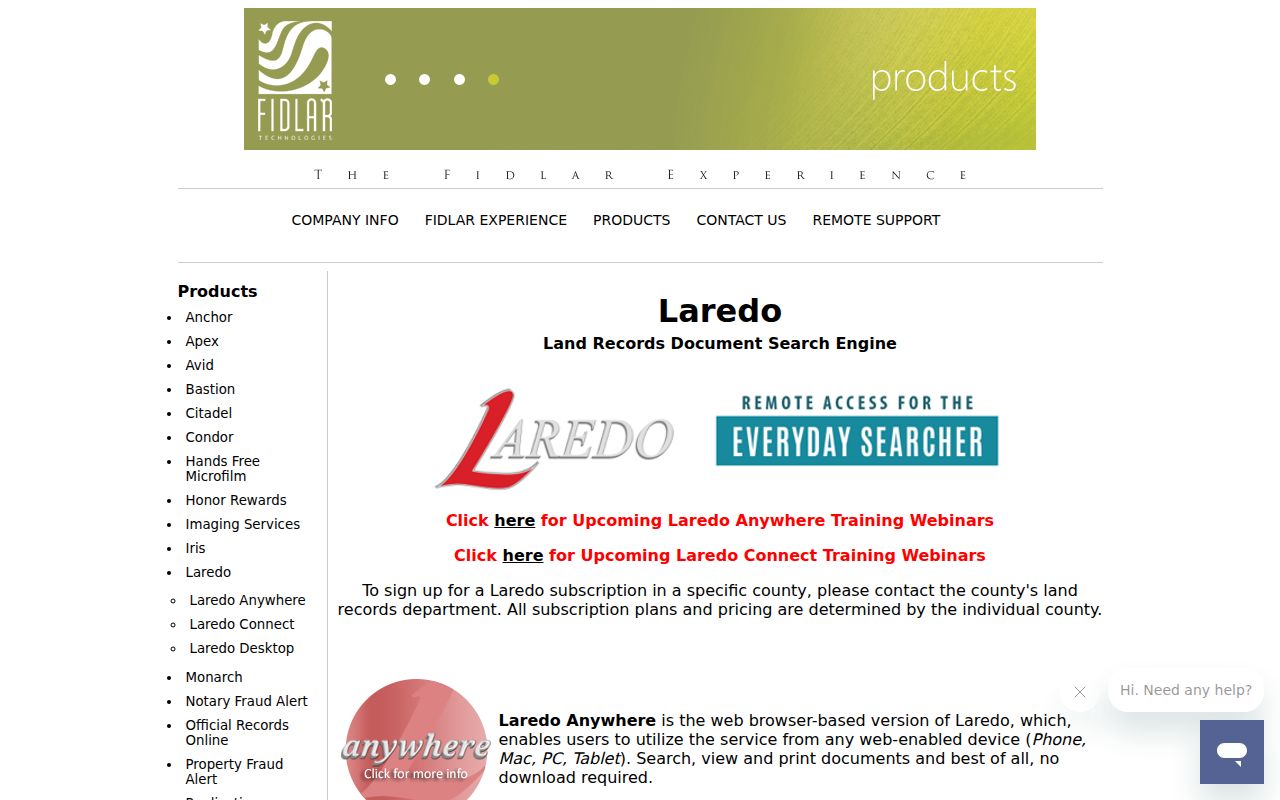
The service screen names the platform. The county guide supplies the historical codes, and occasional users may prefer Tapestry at $8.95 per search plus $1 per printed page. The Recorder counter is the fallback.
Walk Floyd County's Deed Chain Backward
Work from confirmed documents. Names alone can mislead. A careful backward walk keeps each former owner tied to the same parcel, using dates as guides and the legal description as the continuity test.
- Find the newest deed and copy its grantor, grantee, date, type, and recording reference.
- Search that grantor as a grantee in an earlier deed, testing name variants when needed.
- Match the lot, subdivision, grant, or section description before accepting the link.
- Repeat until the target era, then move to books, microfilm, or probate records when the index stops.
- Grantor
- The party conveying the recorded interest.
- Grantee
- The party receiving the recorded interest.
- Chain of title
- The linked sequence of transfers affecting the same land.
- Reverse index
- The grantor/grantee route used to move from a known transfer into the past.
- Quitclaim
- A deed conveying the interest held without the assurances of a warranty deed.
Not every document adds an owner. A correction, release, mortgage, or lien can explain the paper trail without changing ownership, and the Floyd County deed records guide covers single-instrument searches and copy options.
Account for Floyd County's Clark Grant Exception
Floyd County dates to 1819. It was carved from Clark and Harrison Counties. The Clark/Illinois Grant Book preserves land material dated 1783 through 1850, including early plans for New Albany and Greenville. Digitization has limits here. Floyd County cannot certify those images, digitized for historical use, because the originals carry predecessor-county recording information. Search "Illinois Grant" with its number. Inspect the Notes and keep the original jurisdiction in mind. The pattern explains why an apparently online 18th-century deed may still need another custodian for a certified copy, and why Floyd County never held every record now visible in its index.
Note: The Laredo book sequence has no lettered deed book I for the 1818-1853 period.
Continue Floyd County Former-Owner Research Offline
The online path can break. Visit or call the Recorder at 311 Hauss Square, Room 115, New Albany, 812-948-5430. The Indiana State Library Floyd microfilm finding aid covers historic county runs on film. The New Albany-Floyd County Public Library History Room adds maps, newspapers, city directories, and local indexes. These can clarify an old address before the deed search resumes. These sources do different jobs. A city directory ties a person to an address in a given year. It proves no title. A plat supplies vocabulary. It fixes the subdivision and lot wording. Only a deed or court-authorized transfer places a former owner in the chain.
Bridge Floyd County Probate Gaps
A deed chain can skip a generation when land moved through probate. Estates, trusts, life estates, and court orders all break one thing. They disrupt the normal buyer-to-seller pattern in Floyd County property records. Floyd Circuit Court handles probate, estate, and trust matters for the county. Public case information is searchable in MyCase. For documents that never reached the index, contact the Floyd County Clerk directly. Then match that case clue to the representative or estate deed recorded against the parcel.
The Indiana State Library guide lists early Floyd probate holdings. They include Will and Bond Record B, covering 1858 through 1864. They also include Will and Court Order Records from 1892 through 1893. These volumes can show who held authority over an estate and how property passed. Still, they support rather than replace the recorded conveyance. The deed of record controls the parcel's chain of title.
Naturalization papers can help too. The same guide identifies Floyd naturalization records from 1854 through 1926. It also lists citizenship-application indexes from 1854 through 1867. Deed indexing sometimes leaves a name ambiguous. In that case, those files may confirm a spelling variant, birthplace, or arrival context. Treat them as identity evidence only. A person counts as a previous owner solely when a deed, representative instrument, or court-authorized transfer applies. It must tie the name to the legal description.
Set Limits on Floyd County Previous-Owner Findings
Former-owner research serves real purposes. It can ground a house history. It can support estate work, or sharpen purchase diligence before a title examination by a professional. An index result, though, is never a title opinion. Floyd County also has no documented courthouse-loss event. Do not invent one to explain a gap in the deed records. Before concluding anything, check spelling, role direction, the legal description, probate filings, original books, and predecessor-county custody.
Lawful use. Floyd County former-owner records support legitimate property and history research. Never use them to stalk, harass, threaten, or harm a living person.
Log every rejected match along with every accepted deed. That audit trail shows a title professional exactly where the public property search stopped. Certified documents or legal judgment must take over from there.
Recorder copies run $1 per page for sheets up to 11 by 17 inches. A $5 certification charge applies. Tapestry and Laredo set their own search, subscription, and printing terms. Before ordering a long chain, decide whether a working image or a certified copy fits the task. A house-history notebook may only need citations and ordinary images. A legal or transactional question may demand certified instruments from the proper custodian. Clark or Harrison County can hold predecessor material.